The store will not work correctly when cookies are disabled.
We use cookies to make your experience better.
To comply with the e-Privacy rules, we need to ask for your consent to use non-essential cookies (such as analytics and marketing). You can allow or decline these cookies. Essential cookies (for things like basket and checkout) will always be used. For more details, please see our Privacy Policy.
Comrades Above All: The Life of Alexandra Kollontai
Comrades Above All: The Life of Alexandra Kollontai
The story of the Marxist-feminist who became the world's first woman cabinet minister and ambassador
Feminism began as a worldwide movement.
Rather than being sealed up in national boxes, feminists worked together across borders.
And this was partly because of how close first-wave feminism was to international socialism.
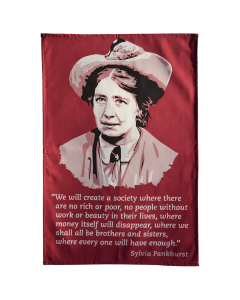
International Women’s Day had its origins in the labour movement, and several leading first-wave feminists were committed socialists: Clara Zetkin, Sylvia Pankhurst, Käte Duncker.
Another was Alexandra Kollontai, who’d go on to become the first woman cabinet minister and first woman ambassador ever.
Feminism as a political movement in the twentieth century has always been deeply embedded in forms of radical leftist politics
Born in St. Petersburg on this day in 1872, Kollontai hardly had the background of a radical socialist feminist.
Alexandra’s family were Russian aristocracy. Her dad was a general in the Tsar’s Imperial Army.
But even under these blueblood conditions, there were some green shoots of progressive politics.
Although part of the Russian elite, Alexandra’s father was a reformer in favour of constitutional government rather than the absolutist status quo.
And Alexandra’s early love of reading and education opened the door to the underground world of left-wing literature in Tsarist St. Petersburg.
After a spell of travelling in western Europe during the 1890s, Kollontai joined the Russian Social Democratic Labour Party (RSDLP) in 1899.
Kollontai went on to become a leading Russian diplomat
Kollontai was on the left of the party, advocating more ambitious forms of working-class opposition to the Tsar’s dictatorship.
And Kollontai was especially ahead of the curve on gender politics.
She soon emerged as a key early theorist of Marxist feminism, criticising bourgeois feminists for their disinterest in the concerns of working-class women:
“Capitalism has placed a crushing burden on woman’s shoulders: it has made her a wage-worker without having reduced her cares as housekeeper or mother.”
Kollontai also developed a doctrine of ‘free love’ as an alternative to the patriarchal family unit:
“In place of the individual and egoistic family, a great universal family of workers will develop, in which all the workers, men and women, will above all be comrades.”
In 1908, Kollontai had to go into exile after she urged Finnish workers to rise up and overthrow Russian imperialism there.
In western Europe, Kollontai continued to network with foreign socialists, especially in Germany, the nerve centre of the Second International.
But Kollontai quit Germany in 1914. Like Rosa Luxemburg, she was outraged by the decision of the German Social Democrats (like their colleagues in Britain and elsewhere in Europe) to support the murderous First World War on ‘patriotic’ grounds.
Meanwhile, back in Russia, the February Revolution of 1917 opened the way for socialist exiles like Kollontai to return.
Kollontai and Luxemburg are two of the leading Marxist feminist theorists of the early twentieth century
But the new Provisional Government continued to support Russian involvement in the war, even though a key driver of the revolution was the popular demand for peace.
Kollontai backed Bolshevik calls to overthrow the new regime, install a socialist government, and exit the war.
In due course, the October Revolution brought the Bolsheviks to power under Vladimir Lenin.
Shortly after, on 26 October 1917, Kollontai was appointed People’s Commissar for Social Welfare, making her the first woman cabinet minister of any European government ever.
She also founded and ran Zhenotdel, the Women’s Department of the revolutionary state.
The new government became the first in Europe to legalise abortion, and to decriminalise homosexuality.
Meanwhile, women elsewhere in Europe were making major gains in revolutionary contexts, too.
The Sinn Fein activist, Constance Markievicz, became the first ever woman MP in the U.K. and Rosa Luxemburg led the German Revolution of 1918-19.
During this time, women like Constance Markievicz were dragging the rest of Europe into the twentieth century
But Kollontai’s radicalism soon clashed with the Bolshevik government’s emphasis on discipline.
Kollontai sided with the Workers’ Opposition during the early 1920s, criticising the creeping bureaucratisation of the Soviet government and its increased distance from the labour movement.
Lenin didn’t appreciate the dissent, and Kollontai narrowly avoided expulsion from the Communist Party. Either way, from 1922 she became permanently marginal in Soviet politics.
Kollontai then took a diplomatic posting to Norway which became a de facto political exile for thirty years.
During that time, she continued to accrue world firsts: in 1943, she became ambassador to Sweden, making her the first ever woman to hold an ambassadorial post.
But in Russia, the October Revolution was undermined and disfigured by Stalin’s purges and bureaucratization.
Kollontai’s diplomatic exile meant she managed to survive this period – she was the last ‘Old Bolshevik’ except Stalin himself to survive into the 1950s.
But she was depressed by what had become of the Russian Revolution. Kollontai died in 1952, far removed from the emancipatory promise she’d felt in 1917.
Years later, Kollontai became recognised as a key theorist of Marxist feminism, whose writings might help correct the shortfalls of the first wave.
The October Revolution may have failed, but there were new revolutions to come – and Kollontai’s legacy would be part of them.
Who were our radical ancestors? What's the legacy we're following? To understand the present, we have to look back at our past, and that's exactly what Pete's radical history emails and blog posts do.
With so many remarkable individuals, It's impossible for Pete to choose his favourite figure from radical history, but if he had to, he'd say Sylvia Pankhurst: "She always appreciated that the struggles for feminist, economic, and racial emancipation are linked together, and she did all of her politics with that truth in mind. Also, like me, she's a Mancunian!"