The store will not work correctly when cookies are disabled.
We use cookies to make your experience better.
To comply with the e-Privacy rules, we need to ask for your consent to use non-essential cookies (such as analytics and marketing). You can allow or decline these cookies. Essential cookies (for things like basket and checkout) will always be used. For more details, please see our Privacy Policy.
Dockworkers were the cutting edge of the American working class.
They knew the international character of economic exploitation and of working-class politics better than anyone.
The Wobblies – the Industrial Workers of the World – had been active in the Pacific ports during the 1920s until they were crushed by a combo of boss-funded lawfare and vigilantism.
But things had changed by 1934.
FDR’s New Deal was an opportunity for increased struggle by organised labour in America.
The early 1930s saw an upsurge in membership of the International Longshoremen’s Association (ILA) on the West Coast.
The ILA was increasingly led from the radical grassroots, and it was a nightmare for the port bosses.
The employers wanted tame ‘company unions’ which did their bidding and kept the workers divided and obedient, rather than the independent, sector-wide and combative model developed by the ILA.
In March 1934, grassroots longshoremen demanded a coastwide contract, so the bosses had to negotiate with the entire Pacific working class at once, not isolated little fragments.
They also wanted a closed shop, to drive out the lackey company unions for good.
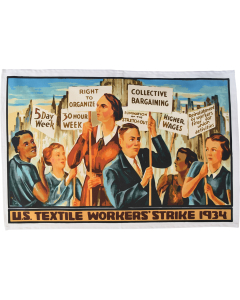
But the bosses wouldn’t budge, so on 9 May every port on the West Coast went on strike.
Along with post-Civil War Reconstruction, FDR's New Deal was one of the most significant progressive moments in American history
The longshoremen were soon joined by the seamen’s union and Pacific trade was shut down.
In response, management recruited strikebreakers and mobilised local police for muscle, but the strike kept growing.
Grassroots Teamsters refused to carry “hot cargo” – goods moved out of the docks by scab labour.
Strikers also successfully disrupted rail transport out of the ports.
But then on Thursday 5 July, escalating police violence against ILA pickets killed two workers – a longshoreman called Howard Sperry and a volunteer cook called Nick Bordoise – at a strike kitchen in San Francisco.
The Governor of California, supporting the bosses, used ‘Bloody Thursday’ as a pretext to deploy the National Guard which was used to escort strikebreakers on the waterfront.
The employers thought they’d won…
But then a mass rally for Sperry and Bordoise prompted calls for a general strike in San Francisco.
On 16 July, 150,000 workers came out in support of the striking longshoremen and sailors.
They were even joined by non-union workers. And middle-class shops, movie theatres, and nightclubs closed in solidarity, too.
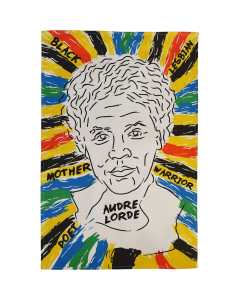
Audre Lorde was born in 1934, the same year as the West Coast Waterfront Strike
On the backfoot, bosses whinged to President Roosevelt and called for military intervention against the general strike. But Roosevelt refused.
So, West Coast elites turned to violence again.
Labour union activists were attacked by police. ACLU labour lawyers were beaten up by right-wing thugs.
Machine gun-armed National Guardsmen and cops were personally directed to attack union properties.
So much for laissez-faire…
Faced with so much state violence, the San Francisco Labor Council buckled and called off the general strike.
Again, the bosses thought they’d won…
But bigger forces were at play here and, for once, they were on the side of the American working class.
Roosevelt’s fast-developing New Deal – one of the most progressive moments in American history – had changed the terms of class struggle.
After the San Francisco climbdown in July 1934, waterfront unions continued to strike spontaneously, pushing their original demands and more besides.
In October, an arbitration decision by a New Deal labour body forced port management to concede most of the ILA’s demands.
The “quickie strike” soon became part of the West Coast repertoire, forcing concessions on pay and conditions on short notice, and solidarity strikes continued regardless of efforts to outlaw them.
The working class built America. And it was strikes like that on the West Coast Waterfront in 1934 that built the working class.
Who were our radical ancestors? What's the legacy we're following? To understand the present, we have to look back at our past, and that's exactly what Pete's radical history emails and blog posts do.
With so many remarkable individuals, It's impossible for Pete to choose his favourite figure from radical history, but if he had to, he'd say Sylvia Pankhurst: "She always appreciated that the struggles for feminist, economic, and racial emancipation are linked together, and she did all of her politics with that truth in mind. Also, like me, she's a Mancunian!"