The store will not work correctly when cookies are disabled.
We use cookies to make your experience better.
To comply with the e-Privacy rules, we need to ask for your consent to use non-essential cookies (such as analytics and marketing). You can allow or decline these cookies. Essential cookies (for things like basket and checkout) will always be used. For more details, please see our Privacy Policy.
The British coalfields in areas like South Wales, Yorkshire, and Lanarkshire were the most radical places in the country.
From Welsh Chartism to the struggles for industrial democracy at the start of the twentieth century, miners often led the fight for the entire working class.
So it’s fitting that, on this day one hundred years ago, the entire working class led the fight for the miners.
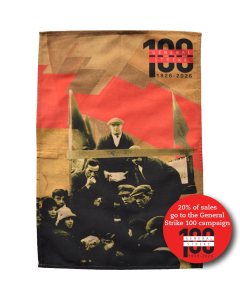
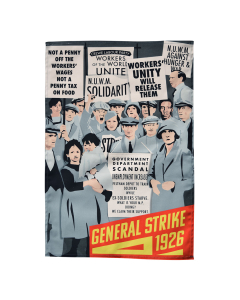
The U.K. General Strike of 1926 – which saw over 1.5 million workers down tools – was waged in solidarity with British coalminers.
The First World War had dislodged Britain’s dominance of the global coal market and the Navy had pivoted to oil, supplied from the colonies.
These shocks squeezed the domestic coal sector.
Rather than sacrifice any of their idly-made profits, mine-owners wanted to transfer all of the cost onto workers.
Backed by the Tory government, the coal bosses proposed a sharp reduction of wages and more hours.
The Miners’ Federation of Great Britain rejected the deal outright:
“Not a penny off the pay, not a minute on the day.”
And the rest of the British working class had their back.
Miners have always been at the vanguard of the British working-class movement, particularly in the struggle against Thatcherism
On 1 May 1926, the Trades Union Congress (TUC) announced a general strike to begin at one minute to midnight on 3 May.
The General Strike mobilised almost 2 million workers to demand the government use its power over the mine bosses to make them accept a fair deal.
Production, transport, warehousing, power supplies – everything the working class does for the country – was brought to a halt.
The solidarity was palpable.
Jessie Eden, a union steward who led women factory workers out to join the General Strike in Birmingham, remembered:
“I was never frightened of the police or the troops because I had the people with me, you see.”
But on the other side of the lines, the government used every dirty trick in the book to undermine the strike on behalf of its pals who owned the coalmines.
Winston Churchill ran a vicious propaganda campaign depicting the strikers as violent insurrectionists and he blockaded the TUC’s paper supply to stop it publishing its own views.
The Army was mobilised to protect strikebreakers.
And a mostly right-wing, middle-class militia, the Organisation for the Maintenance of Supplies, was formed to replace and police the strikers.
The General Strike was actually the first countrywide strike in British history
Early fascist activists were tolerated by the government as a weapon against the workers.
Lawfare was used, too. The court system quickly threatened the trade unions with liability for employers’ losses due to the strike.
Meanwhile, the leadership of both the TUC and the Labour Party, which hadn’t been keen on the General Strike to start with, were now getting desperate for a way to cut and run.
The TUC General Council met the government on 12 May to negotiate an end to the strike.
The delegates requested a guarantee that striking coalminers would be rehired, but now the government pretended it had no influence over the mine-owners’ decision-making.
It was a two-faced lie, of course.
When bosses used their power to screw over workers, the British government pretended it was a matter for the market to sort out itself.
But when workers used their power to force bosses into a fairer arrangement, the government intervened aggressively to stop them.
Despite the government’s brazenness, the TUC capitulated anyway and called off the General Strike.
Abandoned, the coalminers held out alone until November, when those who could still get jobs were starved back into work.
Although let down by its leadership, the organised working class had shown its power – a power that shouldn’t ever be forgotten.
Who were our radical ancestors? What's the legacy we're following? To understand the present, we have to look back at our past, and that's exactly what Pete's radical history emails and blog posts do.
With so many remarkable individuals, It's impossible for Pete to choose his favourite figure from radical history, but if he had to, he'd say Sylvia Pankhurst: "She always appreciated that the struggles for feminist, economic, and racial emancipation are linked together, and she did all of her politics with that truth in mind. Also, like me, she's a Mancunian!"