The store will not work correctly when cookies are disabled.
We use cookies to make your experience better.
To comply with the e-Privacy rules, we need to ask for your consent to use non-essential cookies (such as analytics and marketing). You can allow or decline these cookies. Essential cookies (for things like basket and checkout) will always be used. For more details, please see our Privacy Policy.
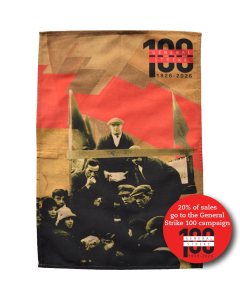
It's one hundred years since the UK General Strike, which took place from 4-12 May, 1926.
This limited edition tea towel and other anniversary merchandise have been designed in collaboration with General Strike 100, which receives 20% of sales
By the mid-1920s, the wages of Britain's coalminers had been falling for years, in the face of competition from abroad (mainly Europe), the government's desire to maintain a strong currency, and mine owners' desire to protect their profits.
Following a report to the government by the 'Samuel Commission' in March 1926, mine owners planned further wage cuts, alongside longer hours.
Poverty among miners, and indeed in the nation as a whole, was widespread in the post-War, pre-NHS 1920s.
The Miners' Federation of Great Britain rejected the mine owners' and the government's proposals.
They were backed by the Trades Union Congress (TUC), which called a 'general strike' - the idea that workers across the whole nation would stop working, in a show of solidarity with the miners.
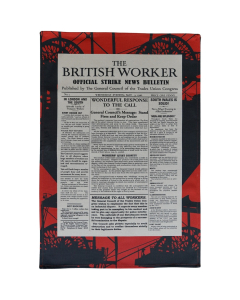
A front page of the British Worker during the strike - it dropped from 8 pages to 4 during the strike period, because Winston Churchill had requisitioned much of the supply of the newsprint
Around 1.7 million workers across the country took part.
They were mainly workers in the railway industry, transport, dockers, printers, ironworkers and steelworkers.
Support might well have been even wider - but some of the union leadership were worried about the strike becoming a little too 'revolutionary'.
Sympathy came from some unlikely quarters, with George V apparently saying to the Earl of Durham, "Try living on their wages before you judge them."
But the government had been preparing for months.
They deployed special constables, volunteers and strike breakers to counter the effects of the strike.
And the government's propaganda - broadcast via the BBC and their own anti-strike newspaper, the British Gazette - presented the strike as a revolutionary action, determined to undermine constitutional government.
Among the anniversary merchandise is an exclusive pin badge, and a passport giving information on all the museums and exhibitions taking place in 2026 to commemorate the strike's centenary
In the face of legal setbacks and the government's tactics, the TUC eventually agreed to call off the general strike, hoping there would be no victimisation of strikers (though this was never guaranteed).
For decades, miners viewed this capitulation as a betrayal by the broader union leadership.
While the TUC ended the wider strike after nine days, the miners fought on alone. They endured punishing poverty and held out until November 1926, when they were essentially starved back to work.
The Trade Disputes and Trade Union Act 1927 then banned future general strikes.
While 'general strikes' have at various points been considered or threatened, none has occurred across the United Kingdom since 1926.
Britain's miners, harrowed by the strike, were divided and remained relatively subdued until the formation of the National Union of Mineworkers at the end of the Second World War.
For many, the strike and its memory inspired the idea that by coordinating and withdrawing their own labour, workers had the power to force change.
But others in the labour movement decided it was time instead to focus on gaining political power through elections.
Luke leads the team at Radical Tea Towel, managing everything from stock planning to the warehouse, but likes to find time to write when he can, whether about new product launches or history.
His favourite bit of radical history is how US independence saw radical 18th century ideas about freedom form the basis of a new political system: "Obviously today we can see the flaws in that imperfect system. But what happened in 1770s America was a wake-up call to power, and created a context in which ordinary people could think about claiming their own freedom. I'm not sure we appreciate how radical that was back then, but it created the modern world."