The store will not work correctly when cookies are disabled.
We use cookies to make your experience better.
To comply with the e-Privacy rules, we need to ask for your consent to use non-essential cookies (such as analytics and marketing). You can allow or decline these cookies. Essential cookies (for things like basket and checkout) will always be used. For more details, please see our Privacy Policy.
Crawford’s mum was a textile worker and her dad was a trade unionist.
It was around 1900 that Crawfurd first became involved in the women’s suffrage movement, though it wasn’t until 1910 that she joined Pankhurst’s militant Women’s Social and Political Union (WSPU).
The WSPU argued direct action, including sit-ins and targeted property damage, was politically necessary to force the British state to concede women’s right to vote.
And Helen Crawfurd soon emerged as one of the organisation’s most effective activists.
She was jailed several times. In 1912 she was arrested for smashing the windows of a Liberal Party cabinet minister, and in 1913 for confronting a group of cops in Glasgow who were trying to disrupt a WSPU rally.
But Crawfurd split with the WSPU leadership in 1914.
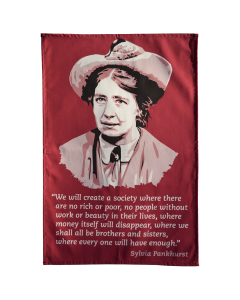
Sylvia Pankhurst and Helen Crawfurd were among those suffragettes who broke from the WSPU over their decision to suspend campaigning during the First World War
Like Sylvia Pankhurst and other left-wing suffragettes, Crawfurd completely disagreed with Emmeline Pankhurst’s decision to suspend WSPU campaigning in support of the First World War.
Crawfurd saw the move as a deal with the devil: an immoral compromise with militarist nationalism in the hopes of receiving women’s suffrage from the British ruling class as a reward
Crawfurd quit the WSPU and joined the firmly antiwar Independent Labour Party (ILP) of her fellow Scottish socialist, James Keir Hardie.
Crawfurd protested pro-war speeches by Emmeline Pankhurst and her loyalist daughter, Christabel.
She also set to building up a feminist antiwar infrastructure in Britain, as an alternative to the compromised WSPU.
In 1915, Crawfurd cofounded a Glasgow branch of the Women’s International League for Peace and Freedom (WILPF).
The iconic women of Greenham Common were carrying on the legacy of Helen Crawfurd's antiwar feminism
She also launched the Women’s Peace Crusade movement in Britain in 1916, which focused on mobilising working-class women for the antiwar movement.
Alongside her direct action, Crawfurd also wrote poetry for the Peace Crusades, including her poem ‘Song of the Women’ –
“Through our land the women gather, Overcoming trial and stress, Great the task we gladly further, On to peace we proudly press.”
Crawfurd’s peace activism was part of a wider engagement with leftist politics after her split from the narrower suffragism of Emmeline Pankhurst.
In Glasgow, Crawfurd was a key organiser of ‘Red Clydeside’, the wave of socialist agitation during and after WW1.
In 1915, for example, Crawfurd helped lead a massive rent strike by over 20,000 working-class tenants in Glasgow against rent hikes.
1918 was a year of victories, albeit partial ones, for Crawfurd’s causes – it saw both the end of the war and the concession of limited women’s suffrage in the U.K.
Like Sylvia Pankhurst, Crawfurd continued to move left in the years after the war, joining the early British communist movement and participating in anti-imperialist politics across Europe.
Since her death in 1954, Helen Crawfurd has been remembered as an icon of Scottish radical history and one of early-twentieth-century Britain’s foremost feminist antiwar activists.
Who were our radical ancestors? What's the legacy we're following? To understand the present, we have to look back at our past, and that's exactly what Pete's radical history emails and blog posts do.
With so many remarkable individuals, It's impossible for Pete to choose his favourite figure from radical history, but if he had to, he'd say Sylvia Pankhurst: "She always appreciated that the struggles for feminist, economic, and racial emancipation are linked together, and she did all of her politics with that truth in mind. Also, like me, she's a Mancunian!"