The store will not work correctly when cookies are disabled.
We use cookies to make your experience better.
To comply with the e-Privacy rules, we need to ask for your consent to use non-essential cookies (such as analytics and marketing). You can allow or decline these cookies. Essential cookies (for things like basket and checkout) will always be used. For more details, please see our Privacy Policy.
This is the story of Joseph Brant, who led a force of Native Americans to fight on the side of the British in the American Revolutionary War...
“Cease […] to call other nations savage, when you are tenfold more the children of cruelty than they.”
The American Revolution wasn’t a matter of clearcut ‘good guys’ and ‘bad guys’…
In terms of a fight between popular sovereignty and tyrannical monarchy, sure, Thomas Jefferson & Co. talked a good game.
But historians have also pointed to the fact that many American Revolutionaries were agitated less by British monarchy than British antislavery.
Early signs of abolitionism in Britain prompted slaveholding white settlers in the Thirteen Colonies to reconsider the transatlantic relationship.
Indeed, many Black Americans chose to fight for the British during the Revolutionary War for the same reason: on the question of slavery, the Revolutionaries were hardly on the ‘radical’ side.
This year we celebrated the 250th anniversary of U.S. Independence - but was the American Revolution really as radical as we think it was?
Another grievance of the American Revolutionary leadership was that the British government was trying to limit settler land grabs at the expense of Indigenous communities.
A Royal Proclamation of 1763 had prohibited settlers from expanding into Indigenous land west of the Appalachians, and the American Revolutionaries wouldn’t stop complaining about it.
For this reason, thousands of Native Americans made the reasonable calculation that their freedom was better served by Britain than the Continental Congress in Philadelphia.
When it came to Native Americans, the American Revolutionaries were fighting for the freedom to conquer them.
The most prominent Indigenous supporter of Britain was a man called Joseph Brant, a Mohawk leader from Ohio Country, on the frontier of European expansion from the colony of New York.
The Mohawks were one of the Six Nations that formed the Haudenosaunee (Iroquois) Confederacy.
Brant’s parents had converted to Christianity and he received a European education in addition to his Indigenous upbringing, so he was familiar with both worlds.
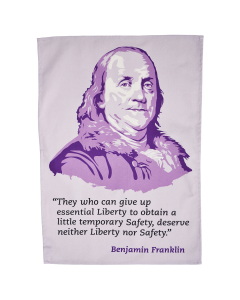
Benjamin Franklin apparently admired the Iroquois Confederacy as a model for a future Union of States, and yet the new American republic went on to dispossess the Iroquois of most of their land
In the decades before the Revolutionary War, the Iroquois enjoyed good relations with Britain, and Joseph Brant gained military experience fighting in the British Army during the French and Indian War.
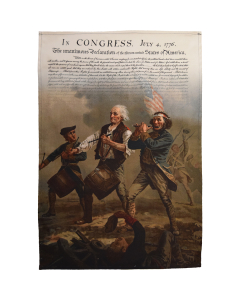
After the Declaration of Independence by European settlers in Philadelphia in July 1776, Brant began lobbying hard for the Iroquois to side with the British.
He argued (presciently) that the independence of the United States would lead to the conquest of Indigenous land, regardless of whose side Native Americans took.
That is, neither neutrality nor siding with the Revolutionaries would save them.
Brant pointed to George Washington’s prewar background as an investor in the Ohio Company – one of the main culprits behind the theft of Iroquois land.
It wasn’t that the British were egalitarian saints – Brant confronted plenty of anti-Indigenous racism from British officers.
Brant’s was a structural point.
The would-be United States was a settler colony whose one motive would be the dispossession and settlement of Indigenous land by Europeans.
Meanwhile, Britain was a global empire with diverse relationships to manage – including alliances with the Native Americans – and so it wanted to put limits on expansionist European settlers in North America for the sake of international stability.
A hundred years after Joseph Brant, Crazy Horse was still fighting off American settlers trying to take Native land
At first, Brant couldn’t persuade the Six Nations and they chose neutrality instead. He was left to lead a small force of Indigenous and European irregulars to fight for Britain.
‘Brant’s Volunteers’ distinguished themselves in battle against the Continental Army despite racist slanders that they were “savages”.
In 1777, Brant received a boost when four of the six Iroquois Nations decided to join the war on Britain’s side, in response to American atrocities on Indigenous territory.
But the reinforcements weren’t enough, Britain lost the war and what Brant had prophesied came to pass.
In addition to a new model of republican self-government, American independence unleashed a wave of conquest against the Indigenous peoples of the continent.
The British, on the other hand, kept their word to Brant, and the Governor of Quebec granted his people land in Canada – what’s still today the Six Nations Reserve – after the new United States conquered the Iroquois homelands.
Like Black Americans emancipated from slavery in return for fighting in the British Army during the Revolutionary War, Brant’s Indigenous Loyalists found a refuge in Canada.
Both groups were castaways of American independence, complicating any radical history of the American Revolution.
When viewed from the perspective of Indigenous and Black communities, it’s not clear that the American Revolution was part of radical history at all.
Who were our radical ancestors? What's the legacy we're following? To understand the present, we have to look back at our past, and that's exactly what Pete's radical history emails and blog posts do.
With so many remarkable individuals, It's impossible for Pete to choose his favourite figure from radical history, but if he had to, he'd say Sylvia Pankhurst: "She always appreciated that the struggles for feminist, economic, and racial emancipation are linked together, and she did all of her politics with that truth in mind. Also, like me, she's a Mancunian!"