The store will not work correctly when cookies are disabled.
We use cookies to make your experience better.
To comply with the e-Privacy rules, we need to ask for your consent to use non-essential cookies (such as analytics and marketing). You can allow or decline these cookies. Essential cookies (for things like basket and checkout) will always be used. For more details, please see our Privacy Policy.
In 1830s Britain, capitalists were using mechanisation to make skilled labourers – especially textile weavers – jobless.
In the event of workers’ opposition, the bosses were backed up by the government – a government workers couldn’t vote for because they weren’t rich enough.
In Llanidloes, only 3% of the town’s population met the property requirement to vote. So for the working-class majority, Britain was a dictatorship.
If the much-vaunted ideal of ‘British liberty’ was to become more than a vacuous slogan, workers needed the vote.
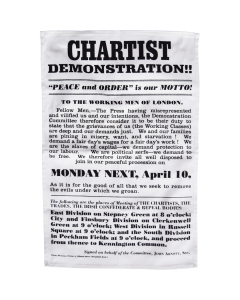
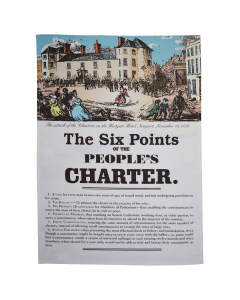
That’s what the Chartists were peacefully demanding in Llanidloes, and that’s what the government feared.
After the Great Reform Act of 1832 had expanded the vote to the middle classes, the Chartists became a voice for working class suffrage
Spooked, the authorities drafted in police from as far afield as London to crackdown on Chartism in Powys.
Three local Chartist leaders – Abraham Owen, Lewis Humphreys, and Thomas Jerman – were arrested and imprisoned at the Trewythen Arms Hotel in the middle of town.
But not for long. Chartist demonstrators easily overpowered the police and freed their leaders, taking control of Llanidloes.
What followed was a festival of democracy: Pum Diwrnod o Ryddid, or Five Days of Freedom.
For five days, Llanidloes was run by its own people as a peaceful and self-governing republic, even striking its own currency.
But this was five days too many for Westminster.
Llanidloes was looking like a dangerously good example of democracy in action – it might spread.
So the government sent in the army to reconquer the town.
The Chartists agreed that armed resistance would be pointless. But their peaceful surrender won them no brownie points with the powers that be.
The judicial system quickly convicted 33 Llanidloes Chartists of treasonous activity, including three women.
Of the leaders, Abraham Owens and Lewis Humphreys were sentenced to ‘transportation’ to penal servitude in Australia – the same fate doled out to many labour activists at the time.
Five years before Llanidloes, the Tolpuddle Martyrs were condemned to penal transportation for forming a union
But one Chartist leader, Thomas Jerman, managed to escape to the U.S.A., catching a ship from Liverpool before he could be arrested.
In America, Jerman continued his radical political career, joining the Union Army during the Civil War to fight for abolition, just as he’d fought for working-class democracy in Wales.
Meanwhile, the British government’s crackdown in Llanidloes had not destroyed Chartism. Just months later there was an even bigger Chartist rebellion down the road at Newport.
The story of Llanidloes may not be as well known as Newport, but it shows just how widespread and popular the democratic struggle in Britain really was.
Because behind every set-piece battle in radical history, there’s a wider movement: Peterloo was followed by a series of solidarity protests across England and Scotland; and Tonypandy was part of a wider wave of industrial militancy in Britain during the early 1910s.
It’s hard enough to get even the big events of radical history onto the mainstream agenda. But that’s still only half the story.
There are whole constellations of small acts that make up our radical past, and they’re well worth remembering, too.
Who were our radical ancestors? What's the legacy we're following? To understand the present, we have to look back at our past, and that's exactly what Pete's radical history emails and blog posts do.
With so many remarkable individuals, It's impossible for Pete to choose his favourite figure from radical history, but if he had to, he'd say Sylvia Pankhurst: "She always appreciated that the struggles for feminist, economic, and racial emancipation are linked together, and she did all of her politics with that truth in mind. Also, like me, she's a Mancunian!"