The store will not work correctly when cookies are disabled.
We use cookies to make your experience better.
To comply with the e-Privacy rules, we need to ask for your consent to use non-essential cookies (such as analytics and marketing). You can allow or decline these cookies. Essential cookies (for things like basket and checkout) will always be used. For more details, please see our Privacy Policy.
The story of how constitutional democracy eventually overcame Ottoman imperialism...
"And musing there an hour alone, I dreamed that Greece might still be free…"
Lord Byron, 1819
After the last of Napoleon’s armies were defeated in 1815, the crowned heads of Old Europe thought they were at last done with revolution.
True, faraway Latin America was still fighting for independence from Spain. But the domestic politics of the great European powers were stable.
The monarchs of Europe – Britain, Russia, Prussia, and Austria – created a region-wide system of surveillance and armed intervention to prevent or else crush democratic activism in future.
The revolutionary genie was well and truly back in the bottle. Or so they thought…
The late eighteenth and early nineteenth centuries became known as the Age of Revolutions, with uprisings across Europe and America
Whereas the other revolutions in southern Europe had been clear-cut challenges to ‘legitimate’ European monarchs endorsed by Christian churches, the Greek revolutionaries were fighting a war of independence against the Muslim rulers of the Ottoman Empire, the old enemy of ‘Christendom’.
Soon enough, it was apparent that the reactionary lords of Europe had no choice but to let the Greeks have a go at toppling their Ottoman rulers.
In fact, Russia – the fanatical lynchpin of counterrevolution in Europe – was directly involved in sponsoring some of the Greek rebels, who began the Revolution by invading the Ottoman-ruled Balkans from Russian territory.
To ‘sell’ the Greek Revolution to conservative Europe, insurgent Greek elites presented it as an Orthodox Christian crusade against Muslim rule.
In this version, the Greek cause was a conservative religious war rather than a popular revolution.
But on the ground in Greece, the reality was very different.
The Battle of Karpenisi, painted by Marsigli Filippo
In practice, the Greek revolutionaries were a motley coalition including plebeian bands of rural horsemen and peasant rebels in the Peloponnese mountains, led by guerrilla captains like Theodoros Kolokotronis.
The Greeks also improvised a navy of their own from the merchant sailors of the Aegean islands.
And many of these Greek revolutionaries weren’t interested in restoring a pre-Ottoman Christian monarchy.
Influenced by the ideas of the American and European revolutions, they wanted a constitutional government based on popular sovereignty.
And internationally, too, the Greek Revolution became a lightning rod for radicals and revolutionaries across Europe.
A “Philhellene” solidarity campaign developed, sending financial aid and hundreds of volunteer soldiers to support the Greek war effort.
The Philhellenes were motivated by Classicist dreams of recreating Ancient Greece but also modern political ideals of constitutional government.
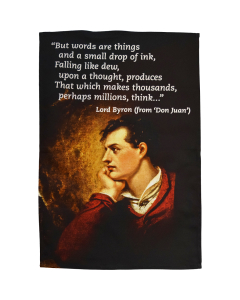
Their most famous volunteer, Lord Byron, died in Greece, creating a wave of sympathy for the Greek cause.
The Romantic poet Lord Byron financed and fought for the Greek Revolution, dying in Greece in 1824
Solidarity with Greece extended far beyond Europe, too.
There were Philhellene volunteers from the U.S.A., like the antislavery activist Jonathan Peckham Miller from Vermont.
And Jean-Pierre Boyer, President of Haiti, sent a message of solidarity to the Greeks from the Caribbean:
"With great enthusiasm we learned that Hellas [Greece] was finally forced to take up arms in order to gain her freedom and the position that she once held among the nations of the world."
But for all the international solidarity, the Ottomans, mobilising their vast military resources, soon had the upper hand in Greece.
By the late 1820s, the Greek revolutionaries were on the ropes.
Lobbied hard by the Greeks and their supporters, an allied fleet of British, French, and Russian warships smashed the Ottoman navy at Navarino in western Greece.
Now unable to resupply or reinforce his armies in Greece, the Ottoman Sultan agreed to recognise a small, independent Greek state in 1832.
The European great powers insisted that the Greeks create a monarchy rather than a popular republic.
But Greece would have independence on its own terms soon enough…
The Greek Revolution had helped smash Old Europe’s post-1815 ban on revolution.
Drawing on the traditions of popular politics forged in the 1820s, the Greeks eventually got rid of the monarchy and created a lasting republic.
And those same traditions also helped fuel the guerrilla resistance to Nazi occupation during the mid-twentieth century.
Revolutionary Greece had proved it: the clock couldn’t be turned back on the Age of Revolutions. Radical history was here to stay.
Who were our radical ancestors? What's the legacy we're following? To understand the present, we have to look back at our past, and that's exactly what Pete's radical history emails and blog posts do.
With so many remarkable individuals, It's impossible for Pete to choose his favourite figure from radical history, but if he had to, he'd say Sylvia Pankhurst: "She always appreciated that the struggles for feminist, economic, and racial emancipation are linked together, and she did all of her politics with that truth in mind. Also, like me, she's a Mancunian!"