The store will not work correctly when cookies are disabled.
We use cookies to make your experience better.
To comply with the e-Privacy rules, we need to ask for your consent to use non-essential cookies (such as analytics and marketing). You can allow or decline these cookies. Essential cookies (for things like basket and checkout) will always be used. For more details, please see our Privacy Policy.
Born in 1816, just after the defeat of the first French Revolution, Pottier was a chansonnier – a worker-songwriter – emerging from the ranks of the French working class.
Pottier was the son of a packer and he trained in textiles while nurturing his passion for music.
By the time of the short-lived French Revolution of 1848, Pottier was already writing socialist songs for working-class audiences.
Most French workers couldn’t read, so music was a more important medium than pamphlets or articles for political organising.
With titles like “Estates General of Labour” and “Liberty, Equality, Fraternity – and Fun”, Pottier was raising the consciousness of the French masses.
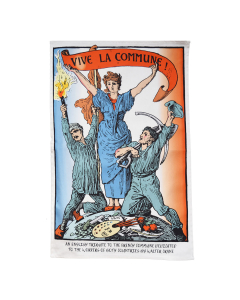
But Pottier’s big moment would be a little later, with the glorious and tragic Paris Commune of 1871.
In the midst of total military defeat by Prussia, with the German army surrounding Paris, the French monarchy was finally overthrown for good and replaced by a republic.
But the Parisian working class wanted more: they wanted socialism.
Previous French revolutions had been betrayed by bourgeois republicans happy to sell out the workers, but not this time.
The Paris Commune took the ideals of the French Revolution one step further: they didn't just want an end to monarchy; they wanted socialism
Supported by the militiamen of the National Guard, a revolutionary Commune took control of Paris in opposition to the new national government of France.
Cheered on by the international socialist movement, the Paris Commune stood for the abolition of capitalism as well as monarchy.
It was all hands on deck in Paris, including for Eugène Pottier.
A member of the socialist First International (led by Karl Marx in London), Pottier was elected to the Commune in March 1871.
He also served on the Commune’s Federation of Artists, headed by the painter, Gustave Courbet.
But the Commune was violently crushed in May 1871.
Colluding with the German invaders, the national government conquered Paris and massacred thousands of working-class activists in the city.
It was only in the weeks after the bloody defeat of the Paris Commune, and before he went into exile in the U.S.A., that Pottier wrote “L’Internationale”.
The song denounced those who’d betrayed the revolution and reaffirmed the belief that socialist internationalism would rise again, phoenix-like, from the Commune’s ruins:
Of the past let us wipe the slate clean Slave masses, arise, arise The world is about to change its foundation We are nothing, let us be everything.
For years, the song went unpublished while Pottier scraped out a living as a French teacher in New Jersey, while also helping to set up one of the first American socialist parties.
It was only after Pottier returned to Paris in 1881 and reconnected with some old Communard comrades that “L’Internationale” went to print in 1887.
Marx's pamphlet "The Civil War in France" was a rallying cry in support of the Parisian communards
At first, it was set to the tune of the original French revolutionary soundtrack, “La Marseillaise”.
It was another socialist musician, the Belgian Pierre De Geyter, who gave “The Internationale” its modern tune while writing for a workers’ singing club in France.
From then on, during the decades after Pottier’s death, his song flourished.
It received its first English translation in the U.S. publishing house of Charles H. Kerr in Chicago, the son of slavery abolitionists and an early American socialist.
The song was adopted by the Parti Ouvrier Français (French Workers Party). Then, in 1896, members of the German Social Democratic Party heard about it.
Inspired by the song’s message of working-class internationalism, the Germans pushed for “L’Internationale” to be the anthem of the socialist Second International – effectively the UN of socialist and labour parties.
A few years later, in 1917, Pottier’s track was adopted as the anthem of the Russian Revolution.
Since then, endless new versions have been made. Toscanini even did a cover to celebrate the Allied victory over fascism in the Second World War.
Pottier, the chansonnier born in the ruins of the French Revolution and forged in the defeat of the Paris Commune, lived on – as does his message.
Who were our radical ancestors? What's the legacy we're following? To understand the present, we have to look back at our past, and that's exactly what Pete's radical history emails and blog posts do.
With so many remarkable individuals, It's impossible for Pete to choose his favourite figure from radical history, but if he had to, he'd say Sylvia Pankhurst: "She always appreciated that the struggles for feminist, economic, and racial emancipation are linked together, and she did all of her politics with that truth in mind. Also, like me, she's a Mancunian!"