Free UK postage on orders over £35! (Use .com site for US)

Shame on the Tyrants: The Story of the Highland Clearances

On this day in 1792, the 'Year of the Sheep' protests began against the Highland Clearances...

“Oh shame on the tyrants who brought desolation
Who banished the brave and put sheep in their place;
Where once smiled the gardens rank weeds in their station
And deer are preferred to the leal-hearted braves.”
If economic injustice had a motto it would be ‘there is no alternative.’
 
It’s a magical spell for exploiters, presenting things which can be resisted as if they were inevitable.
 
There are few clearer examples of this ploy than the Highland Clearances – the Fuadaichean nan Gàidheal (Eviction of the Gaels) – in Scotland.
 
Highland Clearances
Behind the beauty and the sublimity of the Highlands is a history of displacement, poverty and forced emigration
See the Highland Clearances tea towel
 

From the mid-eighteenth to the mid-nineteenth century, vast tracts of Scottish common land were stolen from small farmers by large landlords.
 
The robbers were backed by the government in London, which rubberstamped the mass theft as ‘agricultural improvement’.
 
Over the course of a century, the creation of large sheep farms drove Scottish tenant farmers off their land, into dependent forms of wage labour in the towns, emigration abroad, or else death from poverty.
 
This is the material history behind the romanticised, castle-strewn emptiness of the modern Highlands: a drawn-out process of class warfare from above. 
 
But from the outset, the Highland Clearances were courageously and inventively opposed by the Gaelic-speaking peasantry. 
 
In fact, the Clearances only properly began in response to a Highland rebellion. 
 
After more than a century of the British central state trying to dismantle the Scottish clan system, which included customary protections for common land ownership, thousands of Highlanders took part in the last Jacobite Rebellion of 1745. 
 
Fought to restore the Stuarts to the throne of Great Britain, the Rebellion also expressed the anger of a Highland social system under increasing strain from the growth of British capitalism.

 
Enclosures
During the sixteenth, seventeenth and eighteenth centuries, common land across the British Isles was enclosed and privatised by landowners and aristocrats
See the Enclosures tea towel
 

The final defeat of the Jacobites at Culloden, near Inverness, allowed the British government to abolish Highland chiefs’ heritable jurisdictions – the last major obstacle to a fully privatised land market. 
 
Over the next few decades, more and more landlords began to evict tenants, enclose common grazing lands and replace them with massive sheep farms.
 
This policy violated the principle of dùthchas, by which Highlanders had an inalienable right to rent land in their clan’s territory.
 
After the initial years of post-Culloden repression, popular opposition to the Clearances took shape. 
 
And it was on this day in 1792 that the so-called “Year of the Sheep” protests began. 
 
In Strathrusdale, in Ardross, tenant farmers correctly identified the new sheep farms in the area as the cause of their increased economic precarity.
 
The Strathrusdale tenants decided to take a stand, and they successfully drove more than 6,000 sheep off their land. 
 
It was the first large-scale protest against the Clearances. 
 
Encouraged by their victory, the tenants hatched a plan to drive all of the new commercial sheep away from the area.
 
This they did over the course of five days. The Highland rebels triumphed again.

 
Bastille tea towel
This was a time of huge revolutionary fervour across Europe, including - most notably - in revolutionary France
See the Storming of the Bastille tea towel
 

Inevitably, local elites in Ardross were getting nervous. 
 
These were the years of the French Revolution in Europe. A social protest in the Highlands might cascade into something even more transformative across Scotland and Britain. 
 
So an army regiment was sent north and the protestors were forcibly dispersed. 
 
Some were arrested for assault, others for sedition. Two were convicted and sentenced to deportation to Australia. 
 
Yet the anti-Clearance protests continued.
 
There was constant, low-level opposition, often led by women, which took the form of destroying eviction notices, rustling sheep, and ‘poaching’ on the newly privatised land. 
 
And there were more pitched fights like the one in 1792. 
 
As late as 1882, tenant crofters on the Isle of Skye ignored their landlord’s ban on grazing newly-privatised land and refused to pay him rent. They also successfully resisted eviction, battling 50 police sent north from Glasgow.
 
But in the end, by hook and by crook, the Highland Clearances succeeded. 
 
Rural Scotland was privatised, marketized, and depopulated, the Gaelic culture of its people displaced by Victorian landlords cosplaying ‘Highland life’.
 
But whether or not you’re from Scotland, the Highland Clearances are a part of all our stories. 
 
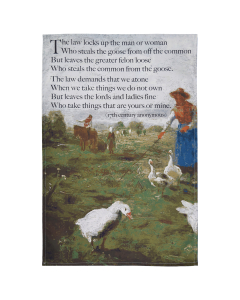
They’re one of countless acts of ‘enclosing’ – or ‘stealing’ – what was once held in common. 
 
But that theft, as the anti-Clearance protests show, never happened without opposition. 
 
These protests are part of a deep history of radical land-based politics in Britain and across the world, from Kett’s Rebellion to the Kinder Scout Mass Trespass, from the Irish Land War to the Mexican Revolution.

Related Products

Copyright © 2025 Radical Tea Towel. All rights reserved.