The store will not work correctly when cookies are disabled.
We use cookies to make your experience better.
To comply with the e-Privacy rules, we need to ask for your consent to use non-essential cookies (such as analytics and marketing). You can allow or decline these cookies. Essential cookies (for things like basket and checkout) will always be used. For more details, please see our Privacy Policy.
Roses, Roses: The Life of America's 'Rebel Cinderella'
Roses, Roses: The Life of America's 'Rebel Cinderella'
Rose Pastor Stokes was an icon of American socialism in the early twentieth century
“Industry, agriculture, yes. Bread, security, yes. But Roses, Roses, yes, a thousand times yes!”
She’s been called the “Rose of the Ghetto” and the “Rebel Cinderella”. In her day, Rose Pastor Stokes was maybe the most prominent radical woman in America.
Born on this day in 1879, Stokes had a similar background to several other Gilded Age revolutionaries.
Like Emma Goldman, Stokes was a Jewish immigrant to the U.S. from the Russian Empire.
As a child, her family moved first from Poland to the East End of London, then, in 1891, they crossed the Atlantic to Cleveland, Ohio.
And it was in the U.S. that Rose Stokes became part of the multiethnic (and rebellious) American working class.
Maybe we need a Rose Pastor Stokes tea towel to go with our Emma Goldman design - what do you think?
For a decade, Stokes worked at a cigar factory, helping to support her mother and siblings.
Increasingly involved in labour activism, she also made headway as a writer, getting a column in a Yiddish-language newspaper based in New York.
Through her newspaper work, she met and married the high-society New Englander, James Graham Phelps Stokes, in 1905.
It wasn’t a conventional match for an activist, but it didn’t change Rose’s politics.
By the standards of his class, Graham was sympathetic to the American left. He and Rose both joined Eugene Debs’ Socialist Party of America (SPA) in 1905.
Despite moving to the thoroughly bourgeois community of Westport, Connecticut, Rose was now more involved in labour politics than ever.
She cavorted with socialist intellectuals and sympathisers like Clarence Darrow, Upton Sinclair, and Florence Kelley.
The early twentieth century was a time of real excitement and radicalism on the American left, with iconic strikes like the 'Bread and Roses' strike of 1912
Through the first decade of the twentieth century, Stokes continued writing against the injustice of capitalist society, now for the left-wing daily New York Call:
“Don’t look at the one who has somehow chanced to survive but look down into the pit where the millions struggle weakly, and where millions have succumbed.”
She was also on the frontline of strike organising in the years before WW1.
She helped organise garment worker strikes in New York in 1909 and 1913, and hospitality workers in 1912.
A feminist as well as a socialist, she was also involved in the fight for women’s suffrage and birth control.
But then came the Great War.
America’s entry into the war was accompanied by a vicious, antidemocratic crackdown on progressive politics at home – so much for ‘making the world safe for democracy’.
Despite this, the Socialist Party, unlike most of its sister parties in Europe, had the courage to stand up against the war and militarism.
Debs and thousands of other antiwar critics were thrown in jail or deported simply for exercising their First Amendment right to speak or write against the war.
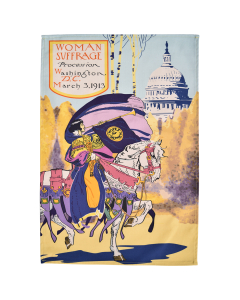
Stokes was also a key player in the American suffragist movement
This ‘First Red Scare’ cowed many progressives into silence or complicity, including Rose’s husband, who quit the Socialist Party and endorsed the war.
But not Rose.
After a brief moment’s hesitation, she rejoined the SPA and committed herself to the antiwar struggle:
“Capitalist society has not succeeded in making me bitter, but it has succeeded in making me unafraid.”
Rose’s antiwar journalism got her sentenced to a decade in prison, although an SPA lawyer got the conviction overturned on appeal.
The experience of how quickly American democracy could be suspended in order to destroy working-class dissent only pushed Rose further to the left:
“…there is not a capitalist or a well-informed person in the world today who believes that this war is being fought to make the world safe for democracy. It is being fought to make the world safe for capital.”
She helped co-found the American communist movement in 1919 with other U.S. radicals, old and new, like ‘Big Bill’ Haywood and John Reed.
For the rest of her life, Rose Pastor Stokes kept to the left of American politics, always agitating for the working-class and hoping for a world better than the capitalist present.
She died of cancer in 1933, still one of the best-known women radicals in U.S. history, and still confident history was on her side:
“We should not be independent like millionaires, nor dependent like laborers. My ideal is that we all be interdependent. And I'm not working in a losing cause.”
Who were our radical ancestors? What's the legacy we're following? To understand the present, we have to look back at our past, and that's exactly what Pete's radical history emails and blog posts do.
With so many remarkable individuals, It's impossible for Pete to choose his favourite figure from radical history, but if he had to, he'd say Sylvia Pankhurst: "She always appreciated that the struggles for feminist, economic, and racial emancipation are linked together, and she did all of her politics with that truth in mind. Also, like me, she's a Mancunian!"