Free UK postage on orders over £35! (Use .com site for US)

Worth a Whole Fleet: The Life of Admiral William Brown

How an Irish merchant sailor became a revolutionary admiral and hero of the Argentine War of Independence...

“Brown in life, standing on the stern of his ship, was worth a whole fleet to us.”
The founder of Argentina’s navy was Irish…
 
Born on this day in 1777, Admiral William “Guillermo” Brown was a hero of the Argentine War of Independence. 
 
But Brown grew up not in Argentina, but in Foxford, County Mayo. This is his story.
 
250 Anniversary
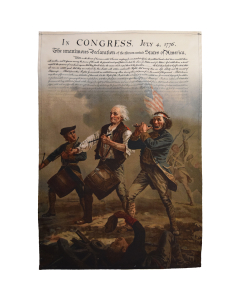
Brown was born in 1777, just one year after the U.S. Declaration of Independence
See the US Independence tea towel
 

As a teenager, William Brown emigrated to the new United States in 1793, and it was in Delaware that Brown began his lifelong career as a sailor, rising from cabin boy to captain on an Atlantic merchant ship. 
 
But then, in 1796, Brown was forced into military service in the Royal Navy to fight in Britain’s wars against revolutionary France. 
 
After a spell as a French prisoner of war, Brown managed to escape British service for good in 1809. 
 
He married an Englishwoman from Kent, Elizabeth Chitty, and then sailed for South America to try his fortune as a merchant sailor again.
 
Since Spain and its colonies had joined Britain’s side in the war against France, Spanish South America opened up as a promising new market for British traders. 
 
William Brown wanted to cash in and start a new life overseas. But the Americas had a surprise in store for him…

 
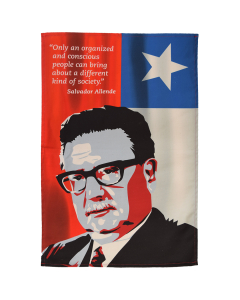
Salvador Allende
From William Brown and Simón Bolívar to Che Guevara and Salvador Allende, South America has a deep and rich radical history
See the Salvador Allende tea towel
 

Napoleon’s invasion of Spain in 1808 had triggered a chain reaction across the Spanish empire, with full-scale wars of independence breaking out across the region. 
 
In Argentina, the conflict properly kicked off with the May Revolution of 1810, when local people deposed the Spanish viceroy and elected their own government instead.
 
And that’s where William Brown came in. 
 
Spanish warships began to harass his merchant shipping in the South Atlantic, suspicious he might be supplying the Argentine rebels. 
 
Meanwhile, the nascent Argentine Republic needed a navy of its own. Brown’s interests and the South American revolution were beginning to align…
 
And there was ideological sympathy, too. 
 
Wolfe Tone’s United Irishmen had recently fought for republican independence back home, and Brown saw in revolutionary Argentina a kindred struggle. 
 
And he wasn’t the only one, either. To the north, in Colombia and Venezuela, hundreds of Irish soldiers had come to join the Liberator Army of Simón Bolívar. Bolívar’s aide-de-camp, Daniel Florence O’Leary, was from Cork. 

 
Thomas Paine
Brown's globe-trotting radicalism sums up the internationalist spirit of writers like Thomas Paine
See the Thomas Paine tea towel
 

William Brown – ‘Guillermo’ to his new countrymen – was commissioned as commander of the newly-founded Argentine navy. Now an Admiral, he’d come a long way from the cabin boy in Delaware…
 
And Brown proved to be a vital military asset for South America. 
 
Sailing from Buenos Aires, his ships smashed the Spanish fleet at nearby Montevideo in May 1814, helping the rebel land army to liberate the strategic city.
 
Brown led from the front aboard his flagship, Hercules. He sailed as far afield as Chile and Perú, through the Straits of Magellan, to disrupt Spanish shipping in the Pacific. 
 
Once Argentina’s independence from Spain became more secure during the late-1810s, Brown retired to his farm inland, a respected founder of the republic and honorary americano.
 
He kept out of the civil wars in the Río de la Plata during the 1820s, fought between those favouring a centralised government in Buenos Aires and a looser political arrangement.
 
But Argentina wasn’t yet secure from outside imperial threats. 
 
Neighbouring Brazil, still a monarchy with close ties to the reactionary powers of Europe, declared war in 1825, hoping to conquer Uruguayan and Argentine territory.
 
Admiral Brown immediately returned to the naval service, defeating a number of Brazilian attempts to blockade Buenos Aires during 1826.
 
At a time when Ireland was unable to win its own liberty, William Brown had found the cause of colonial freedom alive in South America. 
 
When he died in 1857, he was celebrated by the Argentine Republic as the founder who’d won its independence at sea, and a symbol of international solidarity against colonialism.

Related Products

Copyright © 2025 Radical Tea Towel. All rights reserved.