The store will not work correctly when cookies are disabled.
We use cookies to make your experience better.
To comply with the e-Privacy rules, we need to ask for your consent to use non-essential cookies (such as analytics and marketing). You can allow or decline these cookies. Essential cookies (for things like basket and checkout) will always be used. For more details, please see our Privacy Policy.
The absolutist monarchs of Prussia, Austria, Russia, and more besides, feared that the example of the French Revolution might inspire revolutionary fervour in their own countries too.
Encouraged by counterrevolutionary French emigres, European rulers plotted to crush the new French government and restore the absolute power of King Louis XVI.
Meanwhile, several French radicals began to argue they should export the revolution to all Europe.
Theirs was a universalist project. Why should enjoyment of the ‘Rights of Man’ be limited to the French?
And anyway, if the neighbouring monarchies were intent on destroying the French Revolution either way, there was no choice but to fight.
The War of the First Coalition broke out in April 1792, with Prussia, Austria, Russia and Britain ganging up on revolutionary France.
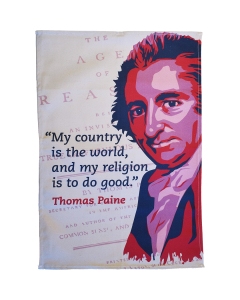
Paine's revolutionary spirit was spreading across the world, but it was met with a huge counterrevolutionary backlash across Europe
The French, of course, had been busy: royal absolutism had ended; popular sovereignty was now the principle of government in France, rather than the divine right of kings.
But King Louis XVI and his hardline allies bristled against the new rights of French citizens.
Louis’ fanatical brothers, along with hundreds of other émigré French aristocrats, marched alongside the Austro-Prussian armies towards Paris.
They were led by the Duke of Brunswick, whose ‘Brunswick Manifesto’ – drafted by Louis’ exiled family – demanded Parisians restore Louis to absolute authority or be destroyed.
But the French people didn’t take kindly to threats, especially from their treacherous so-called ‘nobility’.
The Brunswick Manifesto actually galvanised the French Revolution, the opposite of its intended effect.
The Duke’s invasion provoked the storming of King Louis’ Tuileries Palace on 10 August 1792 by the revolutionary National Guard.
The King was left even more on the back foot in France.
The question now wasn’t whether or not to revert from constitutional to absolute monarchy, but whether to end monarchy altogether and declare a Republic.
And this question would be decided on the field of Valmy.
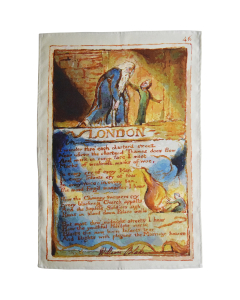
The Romantic poet William Blake was a passionate supporter of the French Revolution, while also railing against poverty and inequality in his own country
Because for everything happening in Paris, there were still 84,000 foreign troops marching on the city to restore royal absolutism.
Two French armies converged on Brunswick’s position near the village of Valmy in the Champagne-Ardennes area of northern France.
The invaders were confident because they had professional soldiers of the sort which had propped up the Ancien Regime in Europe for centuries.
By contrast, the French were reliant on large but inexperienced volunteer militias, fighting out of enthusiasm for the Revolution.
As it turned out, however, having a reason to fight counted.
When Brunswick’s troops advanced on the French line they were met with mass renditions of revolutionary anthems like La Marseillaise, and steely resolve.
Unlike the Germans, the French soldiery at Valmy had a shared stake in the battle.
Their nation was no longer the private possession of a despotic monarch but a public good. Fighting for France meant fighting for themselves together.
Backed up by the French artillery, which was still the best in Europe, the French foot drove Brunswick back.
His army retreated from Valmy, and was then chased all the way back across the Rhine into Germany.
Paris was saved – and the French Revolution was emboldened.
The news of Valmy inspired activists in Paris to seal the deal and formally declare the French Republic.
A spiteful invasion meant to restore King Louis XVI to absolute power had ended with him being reduced to a crownless private citizen, and the creation of modern Europe’s first republic.
Who were our radical ancestors? What's the legacy we're following? To understand the present, we have to look back at our past, and that's exactly what Pete's radical history emails and blog posts do.
With so many remarkable individuals, It's impossible for Pete to choose his favourite figure from radical history, but if he had to, he'd say Sylvia Pankhurst: "She always appreciated that the struggles for feminist, economic, and racial emancipation are linked together, and she did all of her politics with that truth in mind. Also, like me, she's a Mancunian!"