The store will not work correctly when cookies are disabled.
We use cookies to make your experience better.
To comply with the e-Privacy rules, we need to ask for your consent to use non-essential cookies (such as analytics and marketing). You can allow or decline these cookies. Essential cookies (for things like basket and checkout) will always be used. For more details, please see our Privacy Policy.
Born in 1822, Bogle grew up working on small farms in the east of Jamaica.
He knew the grievances of the post-emancipation peasantry because he was one of them.
And he had a talent for leadership, too.
This talent was spotted by George William Gordon, one of the tiny number of non-white residents rich enough to be elected to the colonial assembly.
Gordon sponsored Bogle to become the deacon of Stony Gut Baptist Church, in the eastern parish of St. Thomas.
Gordon opposed the vicious British Governor of Jamaica, Edward John Eyre, who was a close ally of the white plantation-owning class and showed every sign of being nostalgic for slavery.
Eyre happily presided over the corporal punishment of Black so-called ‘criminals’ for the smallest infractions.
Gordon, meanwhile, was having none of it:
“If we are to be governed by such a Governor much longer, the people will have to fly to arms and become self-governing.”
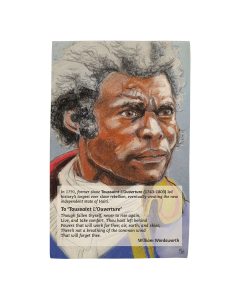
Paul Bogle and Toussaint L'Ouverture are two of the most important liberation fighters in Caribbean history
Paul Bogle was a key part of the struggle against Eyre, able to mobilise the masses in a way the wealthy Gordon couldn’t.
In August 1865, Bogle led a peaceful delegation of peasants on a 45 mile march to meet the Governor to discuss issues about landlessness. But Eyre refused to talk.
Then, in October, two men from Stony Gut were sent to prison for ‘trespassing’ on a huge, abandoned plantation in search of land.
A group of Bogle supporters went along to protest the injustice, and when the colonial police tried to arrest one of them, the people of Stony Gut fought the police off.
Two days later, an arrest warrant was issued for Bogle, but Stony Gut fought off the cops again, driving them back to the nearby port town of Morant Bay.
On 11 October, Bogle then led a partly-armed crowd to Morant Bay itself.
When a colonial militia fired on the march, killing seven protestors, a street battle broke out and the Black peasants won.
For two days, the entire parish of St. Thomas was governed by its people.
Our Windrush tea towel celebrates the many thousands of Caribbean people who came to Britain after WW2 to help rebuild the country
Governor Eyre, over in the capital of Spanish Town, resorted to violence – violence still being the lifeblood and bedrock of the British Empire, despite the end of slavery.
The parish of St. Thomas was flooded with colonial troops who terrorised the population into submission.
Eyre had declared martial law and, behind this smokescreen, 400 Jamaican people were massacred, including women and children.
There were over 300 arrests, too. Paul Bogle and George William Gordon were among those arrested.
Hastily, Eyre had his officials execute both men for conspiracy. Paul Bogle was hanged on this day in 1865.
Giving lie to modern claims that racism and imperialism was simply “of its time” in the era of Cecil Rhodes and Queen Victoria, there was actually a significant backlash among progressives in Britain.
Public intellectuals like Charles Darwin and John Stuart Mill saw through Eyre’s lies and denounced him as a tyrant, a man guilty of murdering his political opponents and brutalising the people he was meant to govern.
British radicals called (unsuccessfully) for Eyre to be sent to prison for mass murder.
Metropolitan solidarity wasn’t enough to save Paul Bogle’s life. But in death he has become a vital part of Jamaica’s anticolonial tradition.
Who were our radical ancestors? What's the legacy we're following? To understand the present, we have to look back at our past, and that's exactly what Pete's radical history emails and blog posts do.
With so many remarkable individuals, It's impossible for Pete to choose his favourite figure from radical history, but if he had to, he'd say Sylvia Pankhurst: "She always appreciated that the struggles for feminist, economic, and racial emancipation are linked together, and she did all of her politics with that truth in mind. Also, like me, she's a Mancunian!"