The store will not work correctly when cookies are disabled.
We use cookies to make your experience better.
To comply with the e-Privacy rules, we need to ask for your consent to use non-essential cookies (such as analytics and marketing). You can allow or decline these cookies. Essential cookies (for things like basket and checkout) will always be used. For more details, please see our Privacy Policy.
O’Higgins, born on this day in the town of Chillán in 1778, is Chile’s most famous Libertador.
His dad, Ambrosio O’Higgins, was from County Sligo.
Like many Irish Catholics who faced persecution under British rule, Ambrosio moved to the Spanish Empire, where he rose through the ranks of the imperial bureaucracy.
The young Bernardo was educated in Chile and Peru, then London and Spain.
Meanwhile, Ambrosio reached the peaks of Spanish imperial power in South America, first as governor of Chile and then as viceroy of Peru.
Ironic, then, that his son Bernardo would help bring all of that to an end…
Nearly two centuries after O'Higgins was born, Allende described him as 'el mejor de los chilenos', 'the best of Chileans'
Bernardo O’Higgins was liberal-minded, and when the war of independence against Spain began in Chile in September 1810, he immediately signed up.
Politically, he sided with the radical wing of the movement, calling for the creation of a National Congress in Chile to anchor its newfound sovereignty.
He also excelled on the military side of things, working closely with another Irish-Chilean, Juan Mackenna.
The Chileans held out bravely in the face of the first royalist effort to reconquer the country by force.
O’Higgins proved himself at the Battle of El Roble, leading from the front, and was soon given full command of the Chilean army:
“Lads! Live with honor, or die with glory! He who is brave, follow me!”
But Chile’s revolution was undermined from within, by factionalism.
O’Higgins was opposed by the brothers Miguel and Luis Carrera, as much due to questions of patronage as politics.
These internal divisions helped the Spanish to overwhelm the Chileans at the Battle of Rancagua in 1814.
Defeated, O’Higgins and other Chilean rebels fled across the Andes to Argentina, where the independence revolution was still ongoing.
Wisely, O’Higgins formed an alliance with the Argentine Liberator, José de San Martin.
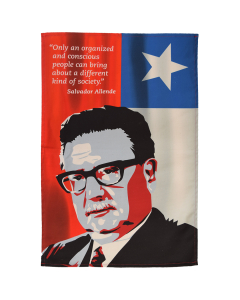
Our Pablo Neruda tea towel includes a message of hope for dark times
San Martin had a plan to conquer the regional hub of royalist counterrevolution in Peru by crossing the Andes, liberating Chile, and invading Lima from the south.
O’Higgins marched at San Martin’s side, commanding the Chilean contingent of his multinational Army of the Andes when it marched west in 1817.
The royalists were taken by surprise.
A quick combo of battlefield victories at Chacabuco and Maipú saw Chile freed for good, and the country was proclaimed an independent republic on 12 February 1818.
San Martin continued on, sailing north to liberate Peru, where he rendezvoused with Simón Bolívar’s armies marching south from Colombia.
Meanwhile, O’Higgins stayed behind in Chile to set up the new state and keep San Martin’s supply lines flowing.
But O’Higgins was soon undone by Chilean factionalism again.
Internal opposition to his centralising moves and fiscal approach led to his ousting in a coup in 1823.
O’Higgins went into exile in Peru (he had originally planned to go ‘home’ to Ireland), and he didn’t return before his death in 1842.
Despite dying in exile, Bernardo O’Higgins is still fondly remembered today as a Libertador – Chile’s Bolívar.
He also forms part of the tapestry of Irish and Irish diaspora radicals who’ve made revolution all over the world.
Who were our radical ancestors? What's the legacy we're following? To understand the present, we have to look back at our past, and that's exactly what Pete's radical history emails and blog posts do.
With so many remarkable individuals, It's impossible for Pete to choose his favourite figure from radical history, but if he had to, he'd say Sylvia Pankhurst: "She always appreciated that the struggles for feminist, economic, and racial emancipation are linked together, and she did all of her politics with that truth in mind. Also, like me, she's a Mancunian!"