The store will not work correctly when cookies are disabled.
We use cookies to make your experience better.
To comply with the e-Privacy rules, we need to ask for your consent to use non-essential cookies (such as analytics and marketing). You can allow or decline these cookies. Essential cookies (for things like basket and checkout) will always be used. For more details, please see our Privacy Policy.
Born on this day in 1880 in Glasgow, Macarthur grew up in a middle-class family.
Her dad had a drapery business, and she studied abroad in Germany before returning to work as a bookkeeper.
Turn-of-the-century Glasgow was a mighty working-class city, and a city shaped by class struggle. Living there, young Mary got an education in British capitalism and the people resisting it.
In 1903, she moved to London to start building a labour movement for working-class women in Britain.
Like Keir Hardie, Macarthur was bringing socialist enlightenment down to England from Scotland.
(In radical history, when in doubt, call the Scottish.)
The mainstream Trades Union Congress (TUC) still excluded women workers, so women built their own.
Macarthur became Secretary of the Women’s Trade Union League (WTUL) in 1903.
This tea towel is based on a postcard from c.1908, originally intended as a parody of the suffrage movement (but we quite like it!)
In 1906, she set up the National Federation of Women Workers (NFWW) as a general union to organise women across the country.
“…women are unorganised because they are badly paid, and poorly paid because they are unorganised.”
Macarthur campaigned against sweatshops, published the Women Worker, and lobbied Parliament for a minimum wage and better conditions.
Meanwhile, she was active in the suffrage movement, too.
Importantly, she pushed the movement to give more consideration to the demands of working-class women.
She was especially adamant that the suffrage movement demand a universal franchise rather than votes for women on the same terms as men – i.e., excluding citizens without enough property.
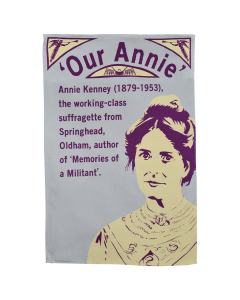
Like Mary Macarthur, Annie Kenney was another iconic working-class woman who fought for women's suffrage
Perhaps unsurprisingly, Macarthur had run-ins with the authorities in both her capacities, as a suffragette and a trade unionist.
In 1913, for example, she was thrown in prison for her part in a sit-in at the Home Office to protest the treatment of suffragette prisoners.
And she was on the frontline of some of the major strikes by women workers during the prewar years.
In 1910, Macarthur organised women chain makers in Cradley Heath, in the West Midlands, to win a fair wage after a 10-week strike.
A year later, she was called in to lead an NFWW strike of 14,000 women workers in Bermondsey against awful working conditions in the food and drink industry.
These actions were the building blocks of a labour movement inclusive of women in the U.K.
When many British women won the right to vote in 1918 it came with a property qualification, excluding much of the working class.
Macarthur continued to campaign against this shoddy compromise until she died of cancer in 1921. It would eventually be overturned in 1928.
Along with the likes of Sylvia Pankhurst, Annie Kenney and Annie Besant, Mary Macarthur ought to be remembered as a founder of socialist feminism in the U.K., an icon of organised labour and the suffragettes both.
Who were our radical ancestors? What's the legacy we're following? To understand the present, we have to look back at our past, and that's exactly what Pete's radical history emails and blog posts do.
With so many remarkable individuals, It's impossible for Pete to choose his favourite figure from radical history, but if he had to, he'd say Sylvia Pankhurst: "She always appreciated that the struggles for feminist, economic, and racial emancipation are linked together, and she did all of her politics with that truth in mind. Also, like me, she's a Mancunian!"